

Curriculum


Bernard Gilpin Primary School:
"Where Children Dream, Believe and Achieve.”
Our educational aim is simple: we are constantly striving to create an exciting learning paradise for all, in which children can succeed and flourish. Courtesy and good manners are at the forefront of our school philosophy. The school curriculum is at the heart of what we do and therefore it is of paramount importance; it has been specifically designed by subject leaders with children at its core, in order to continually improve academic standards and pursue new learning. We strongly believe that teaching children is a privilege and, as such, we are motivated to ensure learning opportunities are adapted and designed around their needs and interests. The decision to purchase two mini buses, which are constantly in use, has further enhanced our children’s learning and understanding to an entirely different level. Giving our children first-hand, real world learning experiences is having a tremendous impact upon standards within our school.
However, learning is not just limited to the pupils: the development and training of staff is immensely important and an integral part to sustainable success. All staff regularly receive high quality training from educational experts across the country, leading to consistently high standards of teaching and expertise across the curriculum.
The school is the “heart of the community.” We have worked enthusiastically to create a caring, family atmosphere where we would like everyone to feel welcome. We believe education is a joint venture between children, parents/carers, staff, Governors and the wider community. Our committed governing body play an active part in the school’s on-going development, and parents/carers have been instrumental in growing our external funding programme by organising fund raising events and arranging fun activities for the children. Working, as we do, in partnership with the community, brings multiple benefits to everyone who both attends the school, and is part of its future.
Our curriculum offers something for everyone. Children are individuals, with a wide variety of gifts and talents fuelled by their interests. We feel that our school caters for the needs of all our children, with a wide, diverse curriculum, supported by extra-curricular activities such as music, the performing arts, sport and computing. By developing these critical elements of school life, we aim to nurture confident, responsible, happy and well-rounded children who are celebrated.
The National Curriculum
The Aims of the National Curriculum:
The National Curriculum provides pupils with an introduction to the essential knowledge that they need to be educated citizens. It introduces pupils to the best that has been thought and said and helps engender an appreciation of human creativity and achievement. The national curriculum is just one element in the education of every child. There is time and space in the school day and in each week, term and year to range beyond the national curriculum specifications. The National Curriculum provides an outline of core knowledge around which teachers can develop exciting and stimulating lessons to promote the development of pupils’ knowledge, understanding and skills as part of the wider school curriculum.
Subject Visions
English
At Bernard Gilpin Primary School, we believe that English is the foundation of learning and empowers every child to communicate confidently, think critically and succeed across all areas of the curriculum. We strive to develop fluent readers, articulate speakers and accomplished writers who leave primary school with the knowledge, skills and confidence to flourish. In line with thestatutory requirements of the National Curriculum for England, the English curriculum develops pupils' skills in speaking and listening, reading and writing through engaging, high-quality learning experiences.
We place systematic synthetic phonics at the heart of early reading, ensuring children develop secure decoding skills that enable them to read with fluency and confidence. As pupils progress, we foster a lifelong love of reading by exposing them to a rich and diverse range of high-quality texts that broaden vocabulary, deepen understanding and inspire curiosity. We recognise that oracy underpins successful learning. Through purposeful opportunities to talk, listen, question, discuss and present, pupils develop the confidence and communication skills needed to express ideas clearly, collaborate effectively and deepen their understanding.
Our writing curriculum equips pupils with the vocabulary, grammar and composition skills to write accurately, creatively andpurposefully for a range of audiences and purposes. Through an ambitious and inclusive curriculum, we fulfil the aims of the National Curriculum by enabling every child to read fluently and with understanding, write effectively, and communicate with confidence, preparing them for the next stage of education and life beyond school.
Mathematics
At Bernard Gilpin Primary School, we believe that mathematics is essential to everyday life and provides children with the knowledge and skills to understand and make sense of the world around them. Our ambition is to develop confident, resilient and enthusiastic mathematicians who leave primary school with the fluency, reasoning and problem-solving skills needed to succeed. In line with the statutory requirements of the National Curriculum for England, our mathematics curriculum develops pupils’ understanding of number, calculation, geometry, measurement and statistics through engaging and challenging learning experiences.
We place secure number knowledge at the heart of mathematical learning, ensuring that children develop fluency in the fundamentals of mathematics through varied and frequent practice. Pupils areencouraged to reason mathematically, make connections between concepts and apply their knowledge to solve increasingly sophisticated problems. We recognise that mathematical talk underpins successful learning. Through purposeful opportunities to explain, justify, question and discuss theirthinking, pupils develop the confidence and vocabulary needed to communicate mathematical ideas clearly and deepen their understanding.
Our curriculum equips pupils with the skills tothink logically, work systematically and persevere when faced with challenge. Through carefully sequenced learning, children develop accuracy, efficiency and resilience, enabling them to apply mathematics across the wider curriculum and in everyday contexts. Through an ambitious and inclusive curriculum, we fulfil the aims of the National Curriculum by enabling every child to become fluent in the fundamentals of mathematics, reason mathematically and solve problems with increasing confidence, preparing them for the next stage of education and life beyond school.
Science
Science is at the heart of the Bernard Gilpin Primary School's curriculum. It encourages children to develop their curiosity, deepen their thinking and improve their practical skills through teaching using real-life contexts, supported by a range of scientific resources and equipment. Children will have a greater appreciation of the natural world, both locally and in a wider setting, and know the impact they can have on the environment. We want children to see themselves as scientists now and in the future. By the end of Year 6, pupils are scientifically literate, curious and prepared for secondary science and in their future lives after school.
Art and Design
The Art and Design curriculum at Bernard Gilpin Primary School is designed to inspire children to become creative, imaginative and reflective artists who are able to express their ideas and emotions with confidence. Through the exploration of a wide range of artists, cultures, materials and techniques, children develop their knowledge, skills and appreciation of art and design in the world around them. The study of Art and Design fosters creativity, resilience and individuality while encouraging children to experiment, take risks and evaluate their own work and that of others. By the end of Year 6, children leave with the confidence and technical skills to create, communicate and respond thoughtfully to art in its many forms.
Computing
At Bernard Gilpin Primary School, Computing equips children with the knowledge, skills and confidence to thrive in an increasingly digital world. Through a progressive curriculum, pupils develop computational thinking, creativity and problem-solving skills whilst learning to use technology safely, responsibly and effectively. We aim to inspire children to become confident digital citizens who can understand, create and apply technology both in schooland beyond. By the end of Year 6, pupils are prepared for the demands of secondary computing and the ever-changing technological world.
Design and Technology
The D&T curriculum is designed to inspire pupils to become creative, innovative and confident designers who can solve real-life problems through purposeful design. Pupils develop practical skills alongside technical knowledge, enabling them to design, make and evaluate products that meet specific needs. Through the study of food and nutrition, mechanisms, structures, textiles and electrical systems, children learn to take calculated risks, think critically and become resourceful problem-solvers. The curriculum encourages resilience, creativity and independence while helping pupils understand the importance of design and technology in everyday life and the wider world. By the end of Year 6, pupils leave with the confidence, knowledge and practical skills to design, create and evaluate products with increasing independence.
French
The French curriculum at Bernard Gilpin Primary School is designed to inspire pupils to become confident and enthusiastic language learners who develop an appreciation of different cultures and the wider world. Through learning the French language, pupils build confidence in listening, speaking, reading and writing while developing the communication skills needed for future language learning. By the end of Key Stage 2, pupils leave Bernard Gilpin Primary School with a secure foundation in French and the confidence to continue their language learning journey at secondary school and beyond.
Geography
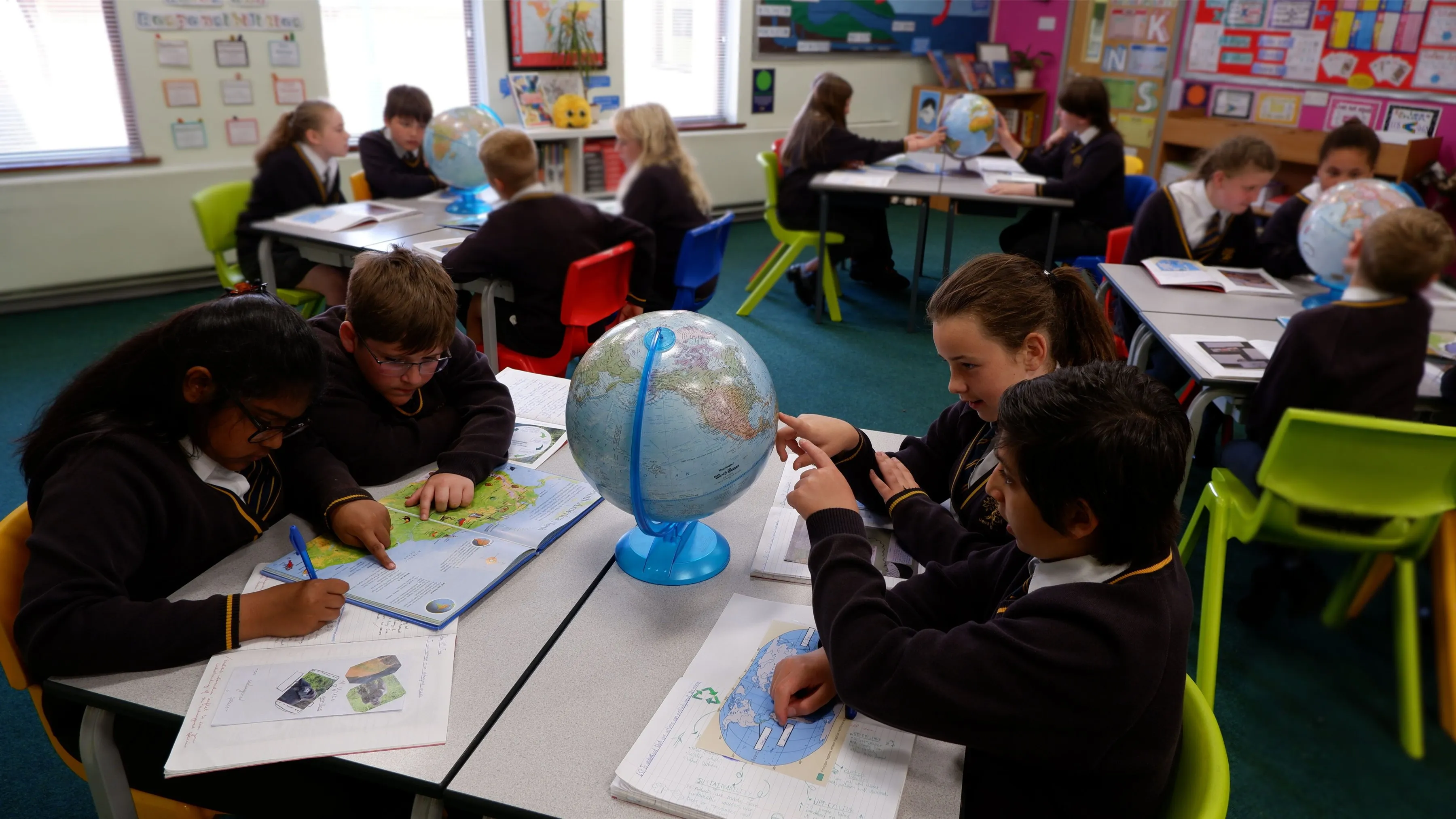
At Bernard Gilpin Primary School, we believe that Geography helps to provoke and provide answers to questions about the natural and human aspects of the world. Children are encouraged to develop a greater understanding and knowledge of the world around them through exploring, appreciating and understanding the environment in which they live and how it has evolved. Geography enables children to develop knowledge and skills that are transferable across the curriculum, whilst also promoting their moral, social and cultural development. Through the study of diverse places, people, environments and natural and human processes, pupils develop a secure understanding of geographical knowledge, enquiry and fieldwork skills. By the end of Year 6, pupils leave with the knowledge, skills and curiosity to understand the wider world and their place within it.
History
The History curriculum at Bernard Gilpin Primary School is designed to inspire pupils to become curious and reflective historians who understand how the past has shaped the world they live in today. Through the study of significant people, events and civilisations, pupils develop a secure understanding of chronology, historical enquiry and the use of sources as evidence. The study of History is fosters respect for different cultures and perspectives while helping pupils appreciate Britain’s place within World history. By the end of Year 6, pupils leave with a coherent chronological understanding of history and the confidence to think critically about the past.
Music
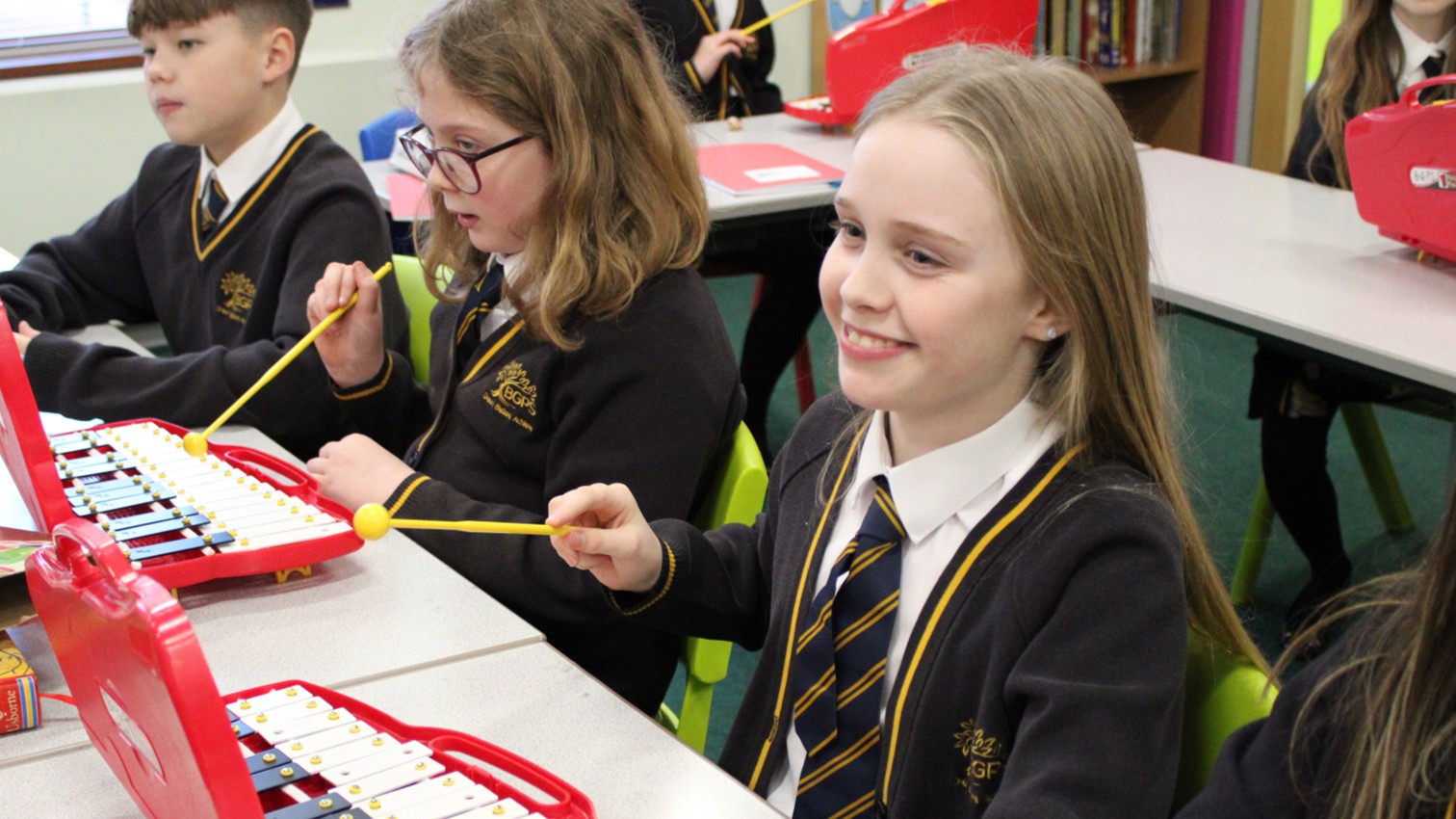
The Music curriculum at Bernard Gilpin Primary School is designed to inspire children to become confident and creative musicians who develop a lifelong appreciation of music and its power to connect people across cultures and generations. Through singing, performing, composing and listening, children develop their musical knowledge, skills and understanding, alongside an awareness of a wide range of musical styles, traditions and genres. The study of Music fosters creativity, self-expression and collaboration while helping children to appreciate the role that music plays in their own lives and in communities around the world. By the end of Year 6, children leave with the confidence to perform, create and respond to music with increasing skill, understanding and enthusiasm.
Physical Education
The Physical Education Curriculum at Bernard Gilpin Primary School has been designed to enhance and develop the teaching and learning of P.E. inclusively throughout the school, supporting pupils to become physically confident in a way which supports their health and fitness. It will ensure all pupils are involved in high quality P.E. teaching and learning experiences by inspiring all pupils to succeed and excel in competitive sport and other physically-demanding activities. Our P.E. curriculum has been created in order to reflect the individual needs of children within our school. At our school, P.E. is valued as an essential component within education, building skills to use across the curriculum and wider life, as well as building upon fundamental movement skills and subject specific knowledge for all children.
P.S.H.E. and R.S.E.
The Personal, Social, Health and Economic curriculum and Relationaships and Sex Education curriculum at Bernard Gilpin Primary School are designed to support children in becoming happy, healthy and responsible members of society who are equipped to navigate the opportunities and challenges of modern life. Through the Jigsaw programme, alongside whole-school assemblies and wider enrichment opportunities, children develop the knowledge, skills and attributes needed to build positive relationships, understand and manage their emotions, celebrate diversity and make safe and informed choices.
The curriculum fosters respect, resilience and empathy while encouraging children to recognise their own value and contribution to the wider community. Through age-appropriate Relationships and Sex Education (RSE), children learn about healthy relationships, personal safety, physical and mental wellbeing and the importance of mutual respect. By the end of Year 6, children leave with the confidence, understanding and emotional literacy needed to thrive in the next stage of their education and beyond.
Religious Education
At Bernard Gilpin Primary School all children follow the Locally Agreed Syllabus for Religious Education (RE). At Bernard Gilpin we believe that RE is important because it prepares children for a life in a twenty-first century world, and it is clear that religion and beliefs play a central role in both local and global affairs. Furthermore, we want to ensure our children understand the importance of acceptance, inclusivity and diversity, both in school and beyond.
There is a clear teaching and learning approach at the heart of the locally agreed syllabus, whereby all units enable pupils to ‘make sense’ of the religions and non-religious worldviews studied, ‘understand the impact’ of these beliefs in people’s lives, and to ‘make connections’ in their own learning and with their wider experience of the world. The curriculum holds an emphasis on RE contributing to pupils’ personal reflection. RE is not simply about gaining knowledge and understanding about religions and beliefs. It also helps pupils to develop their own personal worldviews – their own understanding of the world and how to live, in the light of their learning, developing understanding, skills and attitudes. It makes a significant contribution to pupils’ spiritual, moral, social and cultural development, as well as important opportunities for exploring fundamental British values.
Homework
Homework will be given out every Friday and needs to be completed and returned to school by the following Wednesday. Maths and English homework will be linked to developing the skills which are being taught throughout the year in lessons. In addition to this, children in Years 1, 2 and 3 should use the Lexia online phonics programme for 30 minutes per week and children in Years 4, 5 and 6 should use the online Reading Plus programme for 30 minutes per week. If Internet access is not available at home, arrangements will be made for children to use these online learning programmes in school.
Science Principles

In Science, there are a number of key principles that we follow:
- We enjoy science. We are motivated and enthusiastic about the subject.
- We are confident with our knowledge and application of scientific vocabulary.
- We use a range of scientific equipment and resources with increased accuracy.
- We are inspired through educational visits,visitors, famous scientists, careers and extra-curricular activities.
- We develop our skills through a range of scientific inquiries and investigations,making links to the wider school curriculum.
- We deepen our scientific knowledge when reading a range of science related texts and asking relevant questions.
Music Development Plan